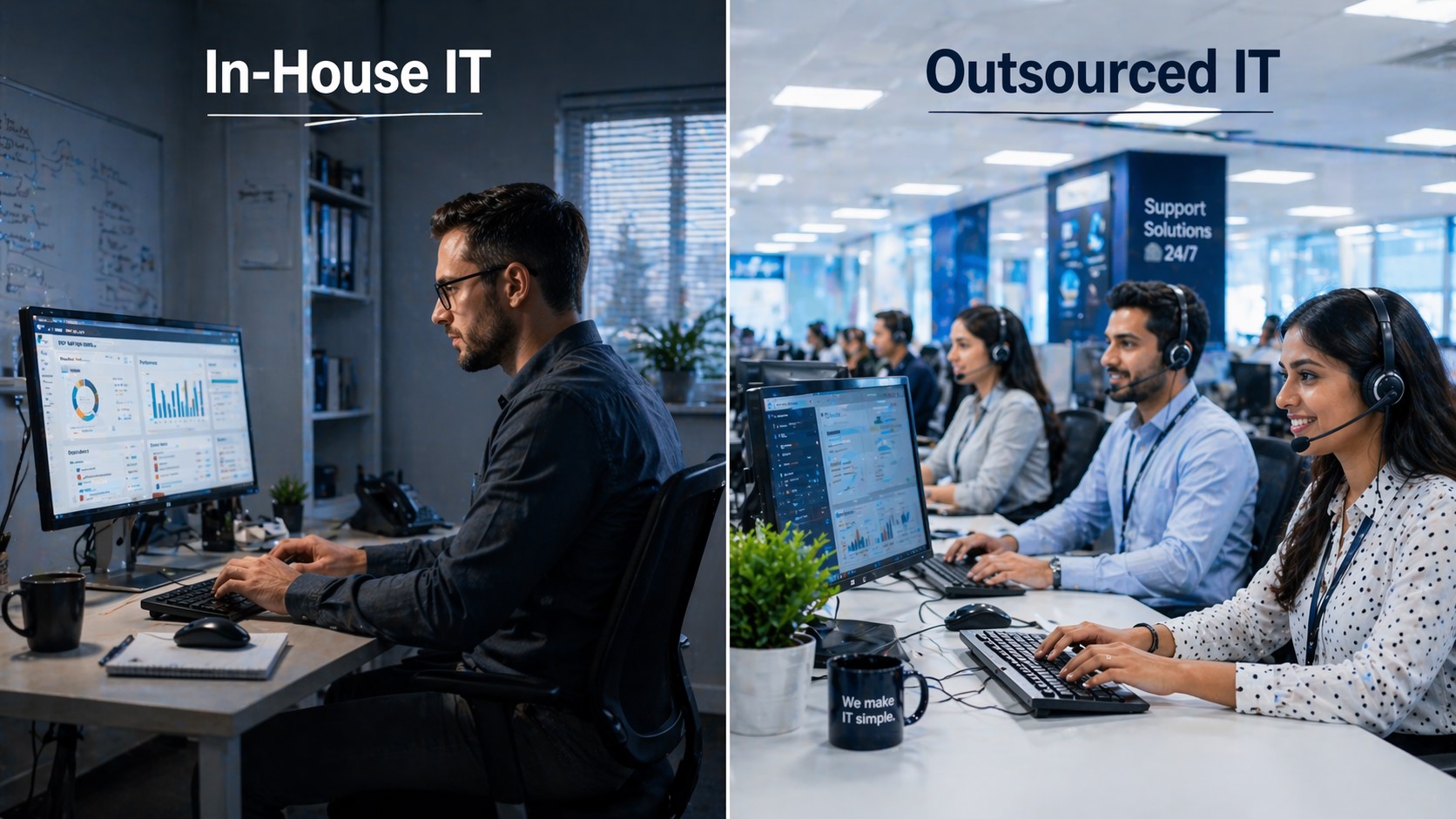
In today’s technology-driven business environment, IT support is no longer optional it’s a critical foundation for operational continuity, security, and growth. Whether you’re a startup finding your footing or an established enterprise scaling operations, one question inevitably arises: Should you build an in-house IT team, or outsource your IT support to a specialist provider? learn how outsourcing builds a scalable business.
Both models have their merits. Both carry trade-offs. The right answer depends on your business size, budget, growth trajectory, and the complexity of your technology needs. In this guide, Globurn Resources Management, a trusted provider of BPO services and BPM services, breaks down the key differences, advantages, and disadvantages of each approach so you can make a confident, informed decision.
If you’re working through the same build-vs-outsource question across other business functions not just IT our broader guide on BPO vs in-house operations applies the same framework across customer service, data processing, back-office, and more
What Is In-House IT Support?
In-house IT support means hiring a dedicated team of IT professionals who work within your organisation. They are your employees on your payroll, under your management, and physically present at your premises. They handle everything from network administration, hardware maintenance, and software support to cybersecurity and helpdesk functions.
This model gives you complete control and deep institutional knowledge of your systems, but it comes at a significant cost.
Pros of In-House IT Support
1. Deep Knowledge of Your Business
An internal IT team becomes intimately familiar with your systems, processes, and workflows. Because they’re embedded in your organisation, they understand the nuances of your infrastructure and can tailor solutions specifically to your needs. This institutional knowledge is a genuine competitive advantage particularly for complex, bespoke environments.
2. Immediate, On-Site Availability
When hardware fails or a critical system goes down, your in-house team is right there. There’s no waiting for a third party to respond to a ticket. Physical proximity means faster resolution for on-site issues a key advantage for businesses where downtime directly translates to revenue loss.
3. Full Control and Alignment
With an in-house team, you set the priorities, the standards, and the pace. There are no contract limitations or third-party SLAs dictating what gets done and when. Your IT team can align directly with your company’s culture, values, and strategic direction.
4. Enhanced Data Security and Confidentiality
For industries dealing with sensitive data healthcare, finance, legal — keeping IT internal can feel safer. You retain direct oversight of who accesses your systems and data, without relying on third-party security practices.
Cons of In-House IT Support
1. High and Ongoing Costs
Building an in-house IT department is expensive. Salaries, benefits, recruitment fees, training programmes, hardware, software licences, and infrastructure investments all add up rapidly. Industry data suggests the average IT professional commands upward of $85,000 annually a substantial commitment, particularly for small and mid-sized businesses.
2. Limited Breadth of Expertise
No single IT professional or even a small team can master the full spectrum of modern technology. From cloud architecture and cybersecurity to network management and software development, IT is vast and multifaceted. Internal teams often excel in one area while leaving gaps in others.
3. Retention and Talent Shortages
Top IT talent is in high demand. Retaining skilled professionals is an ongoing challenge, and losing a key team member can leave your business exposed. Recruitment cycles are long, and the global competition for specialist skills is intensifying year on year.
4. Scalability Constraints
As your business grows, so do your IT demands. Scaling an in-house team in response to rapid growth is slow and costly hiring, onboarding, and training new staff takes time your business may not have.
What Is Outsourced IT Support?
Outsourced IT support involves partnering with an external service provider often called a Managed Service Provider (MSP) or a Business Process Outsourcing (BPO) firm to handle your technology needs. The provider’s team manages your IT infrastructure, responds to issues, and delivers expertise across a broad range of specialisations.
This model offers flexibility, scalability, and access to a wider skills pool without the overhead of full-time employment.
Pros of Outsourced IT Support
This is where BPO services deliver measurable, real-world value for businesses of all sizes
1. Significant Cost Savings
Outsourcing IT support converts unpredictable capital expenditure into manageable, fixed monthly costs. You eliminate recruitment fees, training budgets, employee benefits, and infrastructure overheads. For many businesses, outsourcing reduces IT support costs considerably while delivering a higher standard of service.
2. Access to a Broader Skills Pool
Outsourced IT providers employ teams of specialists spanning every corner of the technology landscape. You gain access to expertise in cybersecurity, cloud computing, data management, software development, and more expertise that would be cost-prohibitive to maintain in-house.
3. Scalability and Flexibility
Outsourced IT teams can scale up or down in response to your business needs quickly and without friction. Whether you’re expanding into new markets, onboarding large numbers of staff, or navigating a quieter season, your support model adapts with you.
4. Proactive, Round-the-Clock Support
Reputable outsourced IT providers don’t wait for things to break. They monitor your systems proactively, identifying and resolving issues before they escalate. Many offer 24/7 support coverage, ensuring your business is protected outside standard working hours.
5. Industry Knowledge and Best Practices
Outsourced IT consultants work across multiple industries and client environments. They bring cross-sector insight, knowledge of emerging technologies, and established best practices that an internal team focused solely on your organisation may never develop.
Cons of Outsourced IT Support
1. Less Business-Specific Knowledge
An external provider won’t know your business the way a long-serving internal team does. Building that relationship and ensuring your provider truly understands your systems, priorities, and culture takes time and deliberate effort.
2. Response Times for Physical Issues
For hardware problems requiring on-site intervention, an outsourced provider may not always be able to respond immediately. It’s important to clarify response time commitments and on-site availability within any service agreement before signing.
3. Contract Complexity and Hidden Costs
Not all IT support contracts are created equal. Some may carry restrictions on scope, additional charges for project work, or clauses that limit flexibility. Thorough due diligence reading the fine print, requesting references, and speaking with existing clients is essential before committing.
4. Trust and Data Security Considerations
Handing access to your systems and data to an external party requires trust. Vet your provider carefully. Look for relevant accreditations, certifications, and a transparent approach to data handling and security governance.
Key Factors to Consider When Choosing
Before making a decision, consider the following:
Business Size: Smaller businesses often find outsourcing more cost-effective. Larger enterprises with complex environments may benefit from a hybrid approach.
Budget: In-house IT carries high fixed costs. Outsourcing offers predictable monthly pricing that scales with your needs.
Growth Plans: If you’re scaling quickly, outsourced IT can flex alongside you without the lag of recruitment.
IT Complexity: The more specialised your requirements, the more you stand to benefit from a provider with a diverse skills pool.
Risk Tolerance: Consider how critical IT uptime is to your revenue and whether you have the internal capacity to manage risks effectively.
Industry Requirements: Heavily regulated industries may have specific compliance needs that influence whether internal or external IT is more appropriate.
The Case for a Hybrid Model
Many businesses are discovering that the choice doesn’t have to be binary. A hybrid model where a lean internal IT team handles day-to-day operations and institutional knowledge, while an outsourced partner provides specialist expertise and overflow support can offer the best of both worlds.
Your internal team takes ownership of tactical, day-to-day issues. Your outsourced partner delivers strategic depth, specialist skills, and the capacity to scale. Together, they create a resilient, comprehensive IT capability that neither could provide alone.
IT is just one piece of the operational cost puzzle. Explore how outsourcing reduces total operational cost across all business functions.
How Globurn Resources Management Supports Your IT Needs
At Globurn Resources Management, we specialise in helping businesses unlock the benefits of outsourcing without sacrificing quality, control, or business alignment. As a Business Process Management company with expertise across business process outsourcing (BPO services), knowledge process outsourcing, BPM services, and human resource outsourcing, we understand that every organisation has unique needs.
Our outsourcing solutions are designed to be flexible, scalable, and industry-specific enabling clients to reduce payroll costs by up to 30%, improve service quality, and build operations that grow with their business. Whether you need dedicated IT support functions, virtual assistance, or a managed service model, our experienced team delivers with precision.
We work across finance, healthcare, transportation, and beyond bringing international experience and a proven track record to every engagement.
Summary
There is no single correct answer in the in-house vs outsourced IT debate. The right model is the one that aligns with your business goals, budget, and operational demands.
In-house IT offers control, familiarity, and immediate on-site availability but at a higher cost with limited scalability.
Outsourced IT delivers cost efficiency, specialist expertise, and flexibility but requires careful partner selection and clear contractual terms.
For business leaders looking to make IT work smarter, outsourcing whether partial or full is an increasingly strategic choice. Partner with Globurn Resources Management to build the right IT support model for your business and discover how our tailored BPO solutions can help you reduce costs, access expert talent, and scale with confidence.
Get in Touch with Globurn Resources Management
If you are weighing whether to keep building an in-house IT desk or hand support to a dedicated partner, we would like to hear from you. We will map out what an outsourced IT support model looks like for your operation with realistic numbers, a clear transition plan, and the technical knowledge to make it work.
📞 India: +91 7719104127 📞 UK: +44 7721046902
Contact us today to explore how outsourcing can support your business goals.
Frequently Asked Questions?