There’s a complaint I hear almost word-for-word every time I sit down with someone from an insurance company, whether they’re running claims operations for a regional insurer or scaling a newer digital-first player: “Our claims are taking too long, and we don’t fully know why.”
It’s rarely one broken thing. It’s usually five or six small delays stacked on top of each other, a form that sits in a queue, a document that has to be re-requested, an adjuster who’s juggling triple the caseload they should be. By the time you add it all up, a claim that should settle in days is stretching into weeks, and the policyholder on the other end is losing patience with every passing day.
Let me walk you through what’s actually changing this, and why more insurers are turning to BPO partners to fix it.
Why Is Claims Processing Time Such a Persistent Problem for Insurers?
Before talking about solutions, it’s worth being honest about why this problem doesn’t go away on its own.
- Manual data entry is still everywhere. A huge share of claims still start life as a scanned form, an email attachment, or a phone call that someone has to transcribe into a system by hand.
- Documentation comes in fragmented and inconsistent. Photos, repair estimates, medical records, and police reports rarely arrive in the same format, at the same time, or through the same channel.
- Internal teams are stretched across too many priorities. Adjusters and claims staff are often handling policy questions, renewals, and escalations alongside new claims, which pushes processing further down the list.
- Volume spikes don’t respect headcount plans. A single weather event or a seasonal surge in claims can double workload overnight, and hiring doesn’t happen that fast.
- Compliance checks add necessary but time-consuming steps. Every claim has to be verified against policy terms, fraud indicators, and regulatory requirements, and doing that thoroughly takes time if it’s not built into the workflow properly.
None of these problems are new. What’s changed is how insurers are choosing to solve them.
What Does a Slow Claims Cycle Actually Look Like From the Inside?
It helps to walk through the stages, because the delay rarely lives in just one place.
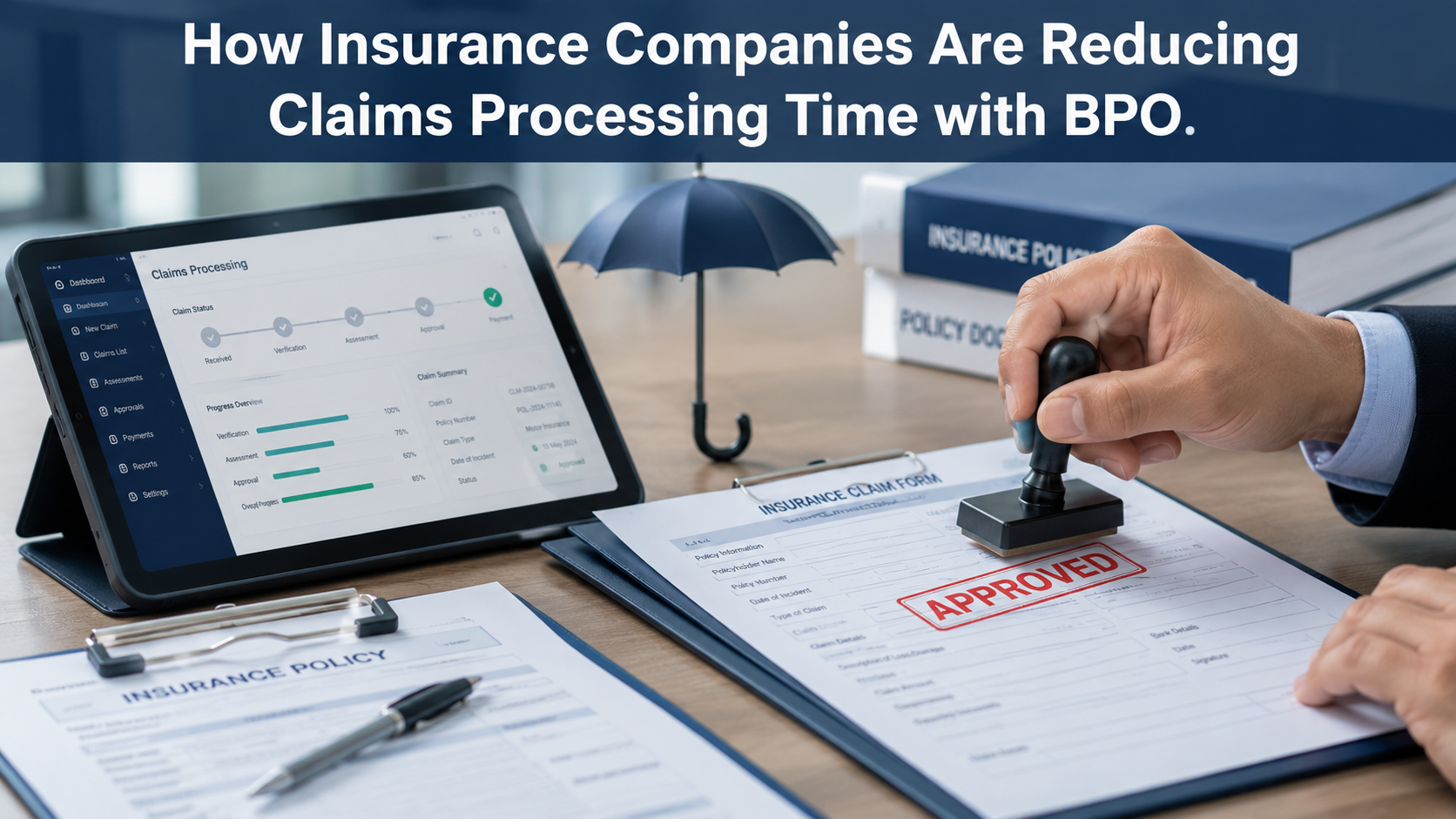
A claim usually starts with First Notice of Loss (FNOL), the moment a policyholder reports what happened. From there, it moves into document collection, where forms, evidence, and supporting paperwork get gathered, often across multiple back-and-forth requests. Next comes verification and validation, checking the claim against the policy, flagging anything unusual, and confirming coverage. Only after that does it reach adjuster review, where a decision gets made. And finally, there’s settlement and payout, the stage the policyholder actually cares about.
If even two of those five stages run slowly, whether from a backlog, a missing document, or an overworked team, the entire claim slows down with them. This is exactly where BPO providers have started making a measurable difference.
How Are BPO Partners Actually Reducing Claims Processing Time?
Here’s where the theory turns into practice, and where the real gains are showing up.
- Dedicated claims processing teams handle the repetitive workload. Instead of your internal adjusters juggling FNOL intake, document chasing, and data entry alongside their actual casework, a trained BPO team absorbs the repetitive front-end steps so your team can focus on decisions that need judgment.
- Document digitization removes the paper bottleneck. Scanned forms, emailed attachments, and handwritten notes get converted into structured, searchable data almost as soon as they arrive, instead of sitting in a folder waiting for someone to key them in.
- Faster, multichannel FNOL intake shortens the starting line. Whether a policyholder calls, emails, or submits a claim online, a BPO team built for this can capture accurate information at first contact, which avoids the delay of a second follow-up call just to get basic details right.
- Automation layered into the workflow speeds up validation. This is where robotic process automation earns its place, handling rule-based checks like policy matching and document verification in minutes instead of hours. We’ve written in more depth about how RPA is reshaping BPO operations if you want to see how this plays out beyond insurance specifically.
- 24/7 support keeps claims moving outside standard business hours. A policyholder who reports a claim at 9 p.m. on a Saturday shouldn’t have to wait until Monday morning for someone to start processing it.
- Scalable staffing absorbs volume spikes without a hiring scramble. When a catastrophe event or seasonal surge hits, an outsourcing partner can flex capacity up quickly, something an internal team constrained by headcount simply can’t do on short notice.
- Analytics-driven process review finds where the real bottlenecks are hiding. Instead of guessing which stage is slow, data-backed review pinpoints it precisely. This is closely related to how data analytics improves customer experience more broadly, and claims is one of the clearest places that shows up.
What Measurable Impact Does This Have on Insurers and Policyholders?
The point of all this isn’t automation or outsourcing for its own sake. It’s what happens because of it.
- Turnaround time drops from weeks to days, in many cases days to hours for straightforward claims that don’t need extensive investigation.
- Error rates fall because structured intake and validation catch inconsistencies early, before they cause a claim to bounce back for correction.
- Cost per claim goes down, because a BPO partner can handle higher volumes without your internal headcount scaling proportionally.
- Policyholder retention improves, because claims speed is consistently one of the biggest drivers of whether a customer renews or walks away after a bad experience.
- Audit and compliance trails get cleaner, since a well-structured outsourced process creates consistent, timestamped documentation by default.
What Should Insurers Ask Before Choosing a Claims BPO Partner?
If you’re evaluating providers, the generic pitch decks will all sound similar. The better questions cut through that.
- How exactly do you handle FNOL intake across different channels, phone, email, and digital?
- What’s your realistic average processing time for a standard claim, and can you show data behind that number?
- How is claimant and policyholder data protected throughout the process?
- Where does automation stop and human judgment take over in your workflow?
- How do you scale your team during a sudden spike in claims volume
- What happens if a claim doesn’t fit the standard pattern, who reviews the exception?
A provider who answers these with specifics, not just reassurances, is telling you something important about how seriously they take claims operations as a discipline, not just a cost line.
How Globurn Resources Management Approaches Insurance Claims Outsourcing
As a growing business process management company, insurance is one of the sectors we take particularly seriously, because the stakes for the person on the other end of a claim are rarely small. A late payout isn’t just an inconvenience; it can be someone waiting to repair their home or cover a medical bill. That weight shapes how we build claims processes for our clients.
Why We Believe Speed Should Never Come at the Cost of Accuracy or Trust
The easiest way to process a claim faster is to cut corners on verification, and that’s precisely the trade-off we refuse to make. Our approach starts with mapping a client’s existing claims workflow in detail before we touch anything, because speeding up the wrong step doesn’t actually help anyone. We look for the delays that come from inefficiency, not the checks that exist to protect the insurer and the policyholder alike.
Building Claims Workflows That Combine Skilled Talent With the Right Technology
Our teams handling claims-related back-office and customer support work are trained specifically around the documentation, terminology, and sensitivity that insurance claims require. Where repetitive, rule-based steps like data entry and document validation can be automated, we build toward that. Where a claim needs a human being to read context, judge intent, or handle a policyholder who’s frustrated or grieving, we keep that firmly in skilled hands. That’s a distinction we also think through carefully in our work on knowledge process outsourcing versus standard BPO, because claims review often sits somewhere between the two.
A Transparent, Founder-Led Approach to Growing Our Insurance BPO Capability
We won’t tell an insurer we can shave 70% off their claims cycle in the first month, because that’s not honest, and honesty is the only foundation a long-term outsourcing relationship can actually stand on. What we will tell you plainly is where we see clear opportunity in your process, what a realistic timeline looks like, and where we think the work should stay in-house, at least for now. Our claims outsourcing capability grows in step with the real needs of the insurers we work with, not ahead of them.
Where This Fits Across the Industries and Service Lines We Support
Insurance is one of several industries we work across, and much of what we’ve learned building claims workflows carries over from adjacent sectors facing similar pressure. If you’re curious how outsourcing decisions play out in a comparable operationally intensive sector, our piece on HR outsourcing versus keeping it in-house covers a similar decision-making framework, even though the function is different.
Reducing Claims Time Is a Partnership Problem, Not Just a Process Problem
Here’s the thing worth sitting with as you think about this decision: the insurers seeing the biggest improvements in claims speed aren’t necessarily the ones with the most advanced technology. They’re the ones who found a partner who understands claims deeply enough to know exactly where a bot should take over, where a person needs to stay involved, and where the current process is slow simply because nobody’s had time to fix it.
That’s the lens we bring to every claims conversation at Globurn Resources Management. We’re honest about where our capability is today, clear about how we think through a claims workflow, and genuinely committed to building a process that serves your policyholders as well as it serves your bottom line.
If you’re rethinking how claims processing fits into your operations, or you simply want a partner who’ll tell you the truth about what’s realistic, we’d love to have that conversation. Get in touch with us, and let’s figure out, together, what faster, more accurate claims processing could look like for your business.
Get in Touch with Globurn Resources Management
If you’re evaluating how outsourcing could help reduce claims processing time in your organisation, and you’re ready to move from “we know it’s slow” to “here’s exactly how we fix it”, we’d like to hear from you. We’ll map out what a claims-focused outsourcing partnership looks like for your specific operations, with realistic timelines, clear process ownership, and the insurance-sector experience to make it work.
📞 India: +91 7719104127
📞 UK: +44 7721046902
Contact us today to explore how outsourcing can support your business goals.
Frequently Asked Questions