There is a version of this story that almost every online retailer knows personally.
You launch. Sales start moving. The product is good, the marketing is working, and suddenly the inbox is full of order queries, return requests, tracking questions, and complaints about a courier that delivered to the wrong address. You hire someone to help. Then another. Then a small team. Then you realise that roughly half your operational energy is being consumed by functions that have nothing to do with why you started the business in the first place.
That is the e-commerce scaling problem, and it arrives for almost every online retailer that grows past a certain threshold. The business model of e-commerce is built on volume, speed, and customer experience. Each of those three things, when handled internally beyond a certain scale, becomes an operational weight that drags on margin and management attention simultaneously.
Business Process Outsourcing (BPO) is how the most operationally mature online retailers have answered this problem. Not by abandoning customer experience, but by entrusting it to specialists built to deliver it at scale.
This article covers exactly how that works, what it covers, what it costs, and what to look for when evaluating it for your own operation.
The E-Commerce Operational Challenge, Plainly Stated
E-commerce businesses face a structural tension that most traditional businesses do not. Their customer-facing demand is inherently unpredictable. A viral post, a flash sale, a feature in a major publication, or simply a seasonal peak can drive order volumes up by multiples of normal, overnight. The fulfilment and support infrastructure required to handle that peak cannot be built and staffed in a week.
At the same time, the margin profile of most e-commerce businesses leaves limited room for carrying the overhead of a fully resourced internal operations team during the quieter periods. You end up either over-resourced and margin-squeezed most of the year, or under-resourced and service-constrained during the moments that matter most.
This is the exact environment BPO was designed to address: high-volume, process-driven, scalable operations that need to flex with demand rather than commit to a fixed cost structure.
If your business is already feeling the weight of operational costs that seem to rise faster than revenue, our article on cutting operational costs through the outsourcing advantage covers the financial mechanics of this problem in detail.
What E-Commerce BPO Actually Covers
The term “outsourcing” is broad. In the context of e-commerce, BPO applies to a well-defined and increasingly sophisticated set of operational functions. Here is what the serious deployment of e-commerce BPO actually looks like.
1. Customer Service and Contact Centre Operations
This is the most commonly outsourced function in e-commerce, and for good reason. Customer service in online retail is high-volume, repetitive in large portions, genuinely important for retention, and expensive to staff well internally.
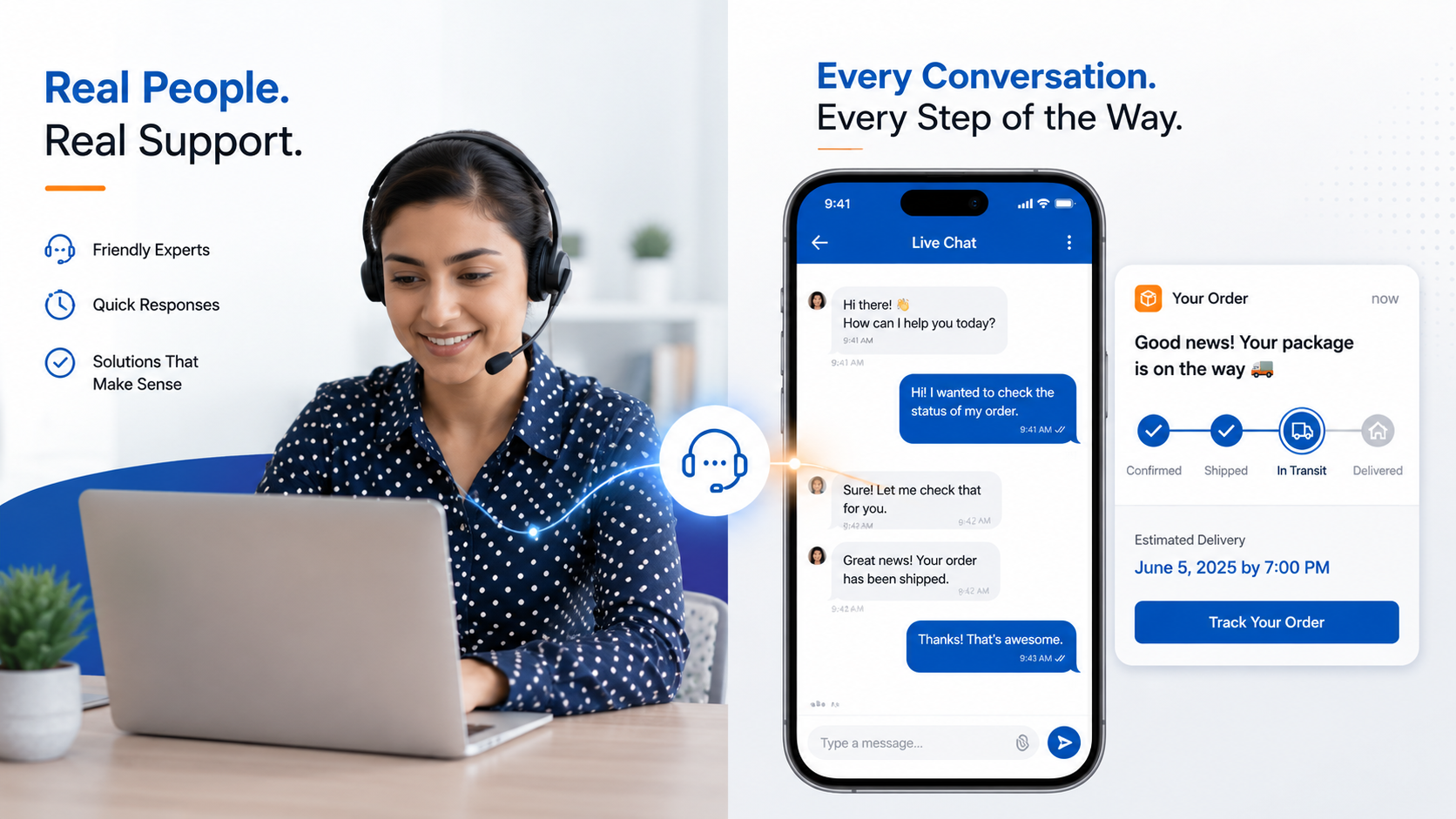
A specialist BPO partner handles the full inbound support function: order queries, shipping and tracking enquiries, returns and exchange processing, complaint resolution, product information requests, and account management. Across phone, email, live chat, and increasingly social messaging channels.
The advantage over building internally is not just cost. It is the trained infrastructure. A BPO provider already has quality assurance frameworks, trained escalation paths, performance monitoring systems, and multi-channel capability that an internal team of equivalent size would take 12 to 18 months to develop properly.
For a detailed understanding of how the strategic role of contact centres translates into measurable business growth, our piece on the strategic role of call centres in business growth is worth reading alongside this one.
2. Returns and Refunds Management
Returns are the operational complexity that most e-commerce businesses underestimate until they are drowning in it. In fashion, the return rate can run as high as 40%. In electronics, dispute and damage claim management adds another layer. In any category, the volume of return-related contacts during peak seasons can exceed normal service ticket volumes.
Outsourcing returns management means a specialist team handles the inbound contact, validates the return request against your policy, processes the refund or exchange in your platform, and manages courier coordination for the physical return. When this process is manual and internal, it consumes disproportionate agent time and creates a bottleneck that directly damages post-purchase satisfaction scores.
A BPO partner processes returns at volume, consistently, with documented quality checks at each step. Your internal team is freed for the work that genuinely requires their product knowledge and organisational context.
3. Order Processing and Data Management
Order processing, including order entry, verification, fulfillment coordination, exception handling for failed payments or incomplete address data, and system updating, is the operational backbone of any e-commerce business. It is also, at its core, process-driven and rule-based work that is well-suited to outsourcing.
BPO providers with data processing expertise handle order workflows at scale, with error-rate targets and processing speed SLAs that deliver consistency most growing e-commerce businesses would struggle to replicate internally. The same capability extends to product data management, catalogue updates, pricing changes, and inventory reconciliation tasks that consume significant internal bandwidth as a business scales.
This connects directly to the broader data management capabilities covered in our article on harnessing the power of data mining to transform BPO operations.
4. Outbound Sales, Upselling, and Retention Calls
BPO in e-commerce is not only about handling inbound problems. Outbound functions including proactive retention calls for customers who abandoned the checkout, upsell and cross-sell programmes for recent purchasers, and win-back campaigns for lapsed customers represent a genuinely high-value deployment of outsourced sales capability.
Building an outbound sales function internally carries significant overhead: recruitment, training, script development, dialler infrastructure, and performance management. A BPO partner with established outbound capability can deploy this function at a fraction of the internal build cost, and begin generating measurable return quickly.
Our article on unlocking revenue growth with proven outbound sales strategies covers the tactical side of this in more depth.
5. Virtual Assistance and Back-Office Administration
Beyond the customer-facing functions, e-commerce businesses generate significant internal administrative work: supplier correspondence, inventory coordination, content review, reporting, and operational admin that does not require senior internal time but consistently consumes it.
Virtual assistance, as part of a broader BPO engagement, takes this workload off your internal team. Experienced virtual assistants handle defined administrative tasks with the same discipline and accountability as any other outsourced function managed to a clear SLA.
6. Fraud Detection and Chargeback Management
Payment fraud and chargeback disputes are an operational reality in e-commerce that most businesses handle reactively and inefficiently until the losses become significant. Specialist BPO support for fraud flag review, chargeback documentation, and dispute submission is an underutilized application that directly protects revenue.
The Real Business Case: Why E-Commerce Businesses Outsource
The motivations behind e-commerce BPO adoption are consistent across business sizes and categories. Here is what the decision actually comes down to.
1.Cost Structure and Margin Protection
E-commerce margin is under pressure from every direction: rising acquisition costs, increasing return rates, platform fees, logistics inflation, and growing customer service expectations. Fixed internal operational overheads compound that pressure.
BPO converts a significant portion of that fixed overhead into variable cost tied to actual transaction volume. You pay for the capacity you use. During peak periods, the partner scales up. During quieter periods, the cost scales back. The financial impact on margin, particularly for businesses with meaningful seasonality, is substantial.
Businesses that have worked through this comparison in full numbers typically find operational cost reductions of 20 to 35% on the outsourced functions, with the full financial picture covered in our analysis of how outsourcing addresses high operational costs.
2.Scalability Without the Hiring Cycle
Every e-commerce founder who has tried to hire, train, and retain a customer service team ahead of a peak season understands exactly how inadequate the standard employment model is for this kind of demand. You cannot hire thirty people in October for a November peak. You cannot retain thirty people through January when order volumes drop by 60%.
BPO solves this structurally. Your partner maintains the trained capacity you need, absorbs the workforce planning complexity, and flexes alongside your volume without the employment cycle overhead on either end.
If building an operationally scalable business is a priority for your growth stage, our guide to building a scalable business with outsourcing covers exactly how this works in practice.
3.Access to Trained Expertise from Day One
A quality BPO provider does not hand you warm bodies and a headset. They bring structured onboarding, product knowledge training, quality assurance monitoring, performance reporting, and escalation management frameworks that most e-commerce businesses have not formally built internally.
That operational infrastructure, built and refined across many client engagements, is available to you from the start of the partnership. It is, in effect, institutional expertise that you would otherwise spend 12 to 18 months building from scratch.
4.Focus Returned to Product and Growth
The opportunity cost of managing an internal operations team is invisible on most P&Ls, but it is real. Founder and leadership attention spent on recruitment, performance management, shift scheduling, and service issue resolution is attention not spent on product development, supplier relationships, marketing strategy, and growth.
When the operational workload is in capable external hands, that attention is freed. In practice, this often has a greater impact on business momentum than the direct cost savings.
What to Look for in an E-Commerce BPO Partner
Selecting the wrong BPO partner in e-commerce is a genuinely damaging experience. Customer service failure is visible, directly, to your buyers. A poor experience at this touchpoint drives returns, negative reviews, and churn.
The selection decision therefore deserves the same rigour you would apply to any critical supplier relationship. Our comprehensive guide on how to choose a BPO company without getting burned covers the full evaluation framework, but for e-commerce specifically, these are the criteria that matter most.
- Multi-channel capability. Your customers contact you by phone, email, live chat, WhatsApp, and social DMs. Your BPO partner needs to handle all of it under a single quality framework, not just calls.
- Platform familiarity. A provider experienced with Shopify, WooCommerce, Magento, or whichever platform you operate will onboard faster, make fewer errors, and manage exceptions more confidently. Ask specifically about platform experience in the selection process.
- Scalability with documented SLAs. Do not take scalability claims at face value. Understand the mechanics: how far in advance they require volume forecasts, what their ramp capacity looks like, and what the SLA commitments are at peak versus baseline.
- Data security and compliance standards. E-commerce operations involve customer personal data, payment information, and order records. GDPR, PCI DSS compliance, and appropriate data handling protocols are non-negotiable foundations. Our article on compliance and security as the pillars of successful outsourcing covers what robust compliance governance actually looks like in practice.
- Reporting and transparency. You should have real-time or near-real-time visibility into the key performance metrics of your outsourced operation: response times, resolution rates, CSAT scores, escalation volumes, and return processing timelines. If a provider cannot show you clearly how they report on performance before you sign, treat that as a material concern.
- Sector experience. A BPO partner with direct e-commerce experience understands the specific patterns, peak demand dynamics, return complexities, and customer expectation profile of online retail. General-purpose BPO without sector experience in e-commerce requires significantly more internal management from your side.
The Transition: How to Move from Internal to Outsourced Operations
The transition from internal customer operations to an outsourced model is where many e-commerce businesses either hesitate or stumble. Done well, it is straightforward. Done poorly, it creates the customer experience disruption that the hesitation was trying to avoid.
Here is the pragmatic approach:
- Start with a defined scope. Do not attempt to outsource everything in a single transition. Begin with a well-documented, high-volume function, typically first-line inbound customer service or returns management, where processes are clear and volume is the primary driver of cost.
- Invest properly in the knowledge transfer. Your BPO partner needs your product knowledge, your policies, your platform access, your escalation rules, and your tone of voice. The investment in getting this right at the start pays back through every interaction thereafter. Treat the onboarding period as an investment, not an overhead.
- Run a parallel period. For the first four to six weeks, maintain some internal capacity alongside the outsourced team. This creates a fallback, surfaces knowledge gaps, and allows quality calibration before full transition.
- Set clear performance baselines and review cycles. Agree on the key metrics that define success before go-live. Set a formal review cadence, weekly initially, moving to fortnightly once performance is stable. The BPO relationship performs best when it is actively managed.
- Plan for growth, not just current state. Structure the partnership to accommodate the business at two to three times current volume. Building the foundations of a scalable operation from the start is far easier than retrofitting it after a growth event.
E-Commerce BPO and Technology: Where It Is Heading
The BPO landscape in e-commerce is not static. The integration of AI-assisted customer service tools, robotic process automation for order and returns workflows, and predictive analytics for demand planning is reshaping what outsourced operations can deliver.
For e-commerce specifically, the most impactful developments are in AI-assisted first contact resolution, where automated handling of routine queries order status, return eligibility, delivery ETAs means a significantly higher proportion of contacts are resolved without agent involvement. This drives cost down and response speed up simultaneously.
The human layer remains essential for complaint resolution, complex return disputes, fraud investigations, and any situation requiring genuine judgement or empathy. The model that works best is the hybrid: intelligent automation handling volume, experienced agents handling what automation cannot.
Our article on the real role of AI in customer support and the BPO industry covers this shift in detail, including what it means for e-commerce businesses evaluating outsourcing today.
The e-commerce brands that will win on customer experience over the next three to five years are those that combine the speed and consistency of automation with the quality and empathy of skilled human support, delivered at a cost structure that protects their margin. That combination is precisely what the best BPO partnerships are now built to deliver.
Why Globurn Resources Management for Your E-Commerce Operations
There is no shortage of BPO providers in the market. What separates a good outsourcing engagement from an expensive disappointment is almost never the cost per agent on the contract. It is the quality of the domain knowledge your partner brings, the robustness of their operational infrastructure, the honesty of their communication when things are difficult, and their genuine investment in your outcomes rather than just their own contract retention.
Globurn Resources Management is a Business Process Management company operating across India , USA and the UK, with an internationally experienced management team and deep operational expertise across customer service, inbound and outbound sales, data processing, virtual assistance, and back-office support.
For e-commerce businesses specifically, what we bring is practical rather than theoretical:
- Experienced call centre and customer service infrastructure with multi-channel capability across voice, email, live chat, and messaging, built to handle the volume peaks and service complexity that online retail generates.
- Inbound and outbound sales teams already trained in the conversion and retention mechanics of e-commerce, capable of handling everything from first-contact order support to proactive upsell and lapsed customer recovery campaigns.
- Data processing and back-office capabilities that cover order management, returns processing, catalogue and inventory data, and the administrative operations that consume internal bandwidth without generating strategic value.
- Scalability built into the model, not bolted on as an afterthought. Our delivery model is designed to flex with your demand, which means you have the capacity you need at peak without carrying that overhead through quieter periods.
- A management team with genuine international experience across finance, retail, healthcare, and transportation sectors, which means we understand the regulatory environment, the customer expectation profile, and the operational realities of businesses serving customers across India, the UK, and beyond.
We do not operate on a one-size-fits-all contract model. We build partnerships that reflect the specific operational needs of each client, with transparent performance reporting and governance structures that give you the visibility and control that a good outsourcing relationship should always deliver.
If you want to understand what outsourcing your e-commerce customer operations could actually look like, with real numbers and a realistic transition plan, we are ready to have that conversation.
Conclusion: The Decision Is Simpler Than It Looks
E-commerce businesses that continue to manage customer service, returns, order processing, and sales support entirely in-house beyond the early growth stage are carrying an operational burden that compounds quietly and expensively over time.
The case for outsourcing these functions is not built on abstract cost theory. It is built on the concrete reality that specialist BPO providers can deliver higher service quality, faster response times, greater scalability, and lower total operational cost than most growing e-commerce businesses can replicate internally, particularly during the peaks that define customer loyalty and brand reputation.
The question is not really whether to outsource. For most e-commerce businesses at the growth stage, the honest answer to that question is already clear. The question is who to partner with, and how to structure the engagement for maximum return.
If you are carrying that operational weight right now, and you are serious about protecting your margin while continuing to grow, connect with Globurn Resources Management today. We will show you exactly what a well-structured outsourcing partnership looks like for an e-commerce business at your stage, and what it is worth.
The customers doing business with you deserve operational excellence. Your business deserves the margin to invest in growth. With the right BPO partner, you do not have to choose between the two.
Get in Touch with Globurn Resources Management
If you run an online retail operation ready to move from firefighting support tickets to structuring a scalable customer service and fulfilment model, we would like to hear from you. We will map out what an outsourcing partnership for your store looks like with realistic numbers, a clear transition plan, and the e-commerce sector knowledge to make it work.
📞 India: +91 7719104127 📞 UK: +44 7721046902
Contact us today to explore how outsourcing can support your business goals.
Frequently Asked Questions?